Slower Tools
Choosing instruments the way you choose materials
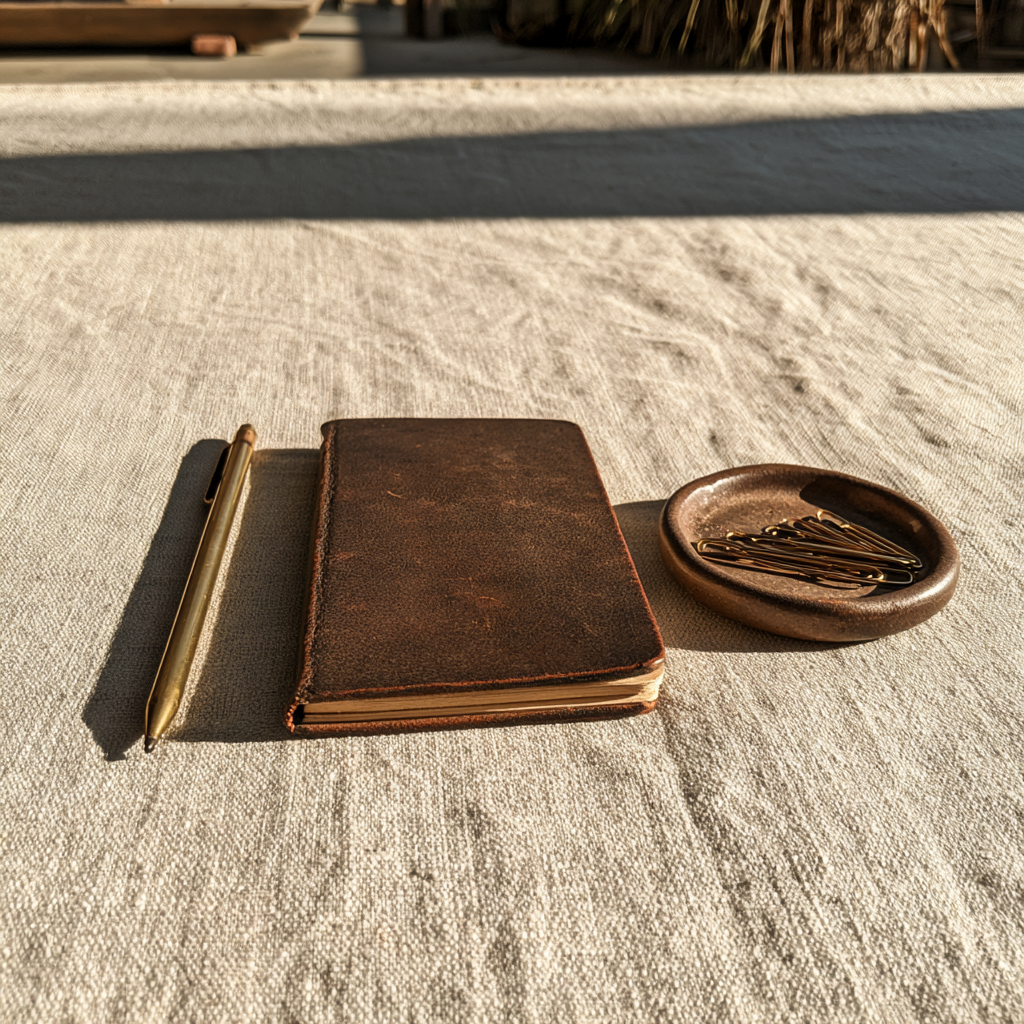
Why the studio owns fewer, heavier tools and keeps them longer — a materials-led way to choose what you work with, on paper and on screen.
A carpenter doesn't own every chisel. They own perhaps six, and they know the weight of each one without looking — which is precisely why the work is good. Somewhere between the app store and the stationery shop, creative people were talked out of this. We collect instruments the way other eras collected porcelain: for the acquiring, not the using. Every new tool arrives promising to be the one that finally makes the work easy, and every workshop it joins gets a little harder to think in.
The studio's position, arrived at expensively: tools are materials. You choose them the way you'd choose paper stock — by hand-feel, by longevity, by whether they disappear into the work. And you choose few.
The tool has to disappear
The test for keeping any instrument, analog or digital, is whether it vanishes while you use it. A good pencil disappears; you're left holding the line. A good writing app disappears; you're left inside the sentence. Any tool you can still feel after ten minutes — configuring it, negotiating with it, admiring it — is furniture, not instrument. The workshop question isn't "what can this do?" It's "how quickly does it get out of the way?"
Weight is information
We keep a bias for tools with weight — brass over plastic, bound over spiral, software that's ten years old and moves like it. Weight, literal or otherwise, is accumulated decisions: someone kept choosing this thing, year after year, and it thickened. Novelty is weightless by definition; it hasn't been chosen twice yet. Let other people run the beta programme. Arrive at version ten.
One tool per verb
The studio's actual rule, and the one that ended our collecting: one tool per verb. One place where writing happens. One place where planning happens. One capture, one calendar, one canvas. The moment a verb has two homes, every use of it begins with a small decision — and those small decisions, hundreds a week, are the leak. Choosing one home per verb isn't limiting; it's the end of a hundred tiny negotiations.
Keep them long enough to soften
The last part is duration. A notebook used for four years develops what leather-workers call a break-in — it opens flat, knows your hand, holds your history in its softened corners. Digital tools soften too, in their way: the shortcuts in your fingers, the archive that thickens, the search that knows your past selves. Every switch resets that to zero. The tenth year with a tool is worth more than the first year with ten.
Fewer, heavier, longer. The workshop gets quieter, and in the quiet you can finally hear the work.
In The Studio Archive this week: the studio's entire toolkit, listed honestly — every tool, every verb, including what each replaced — plus a one-page audit for your own shelf. The post is the standard; the file is the inventory.